
Book recommendation: Queersland
QUEERSLAND is a treasure chest of stories by queer Queensland writers.

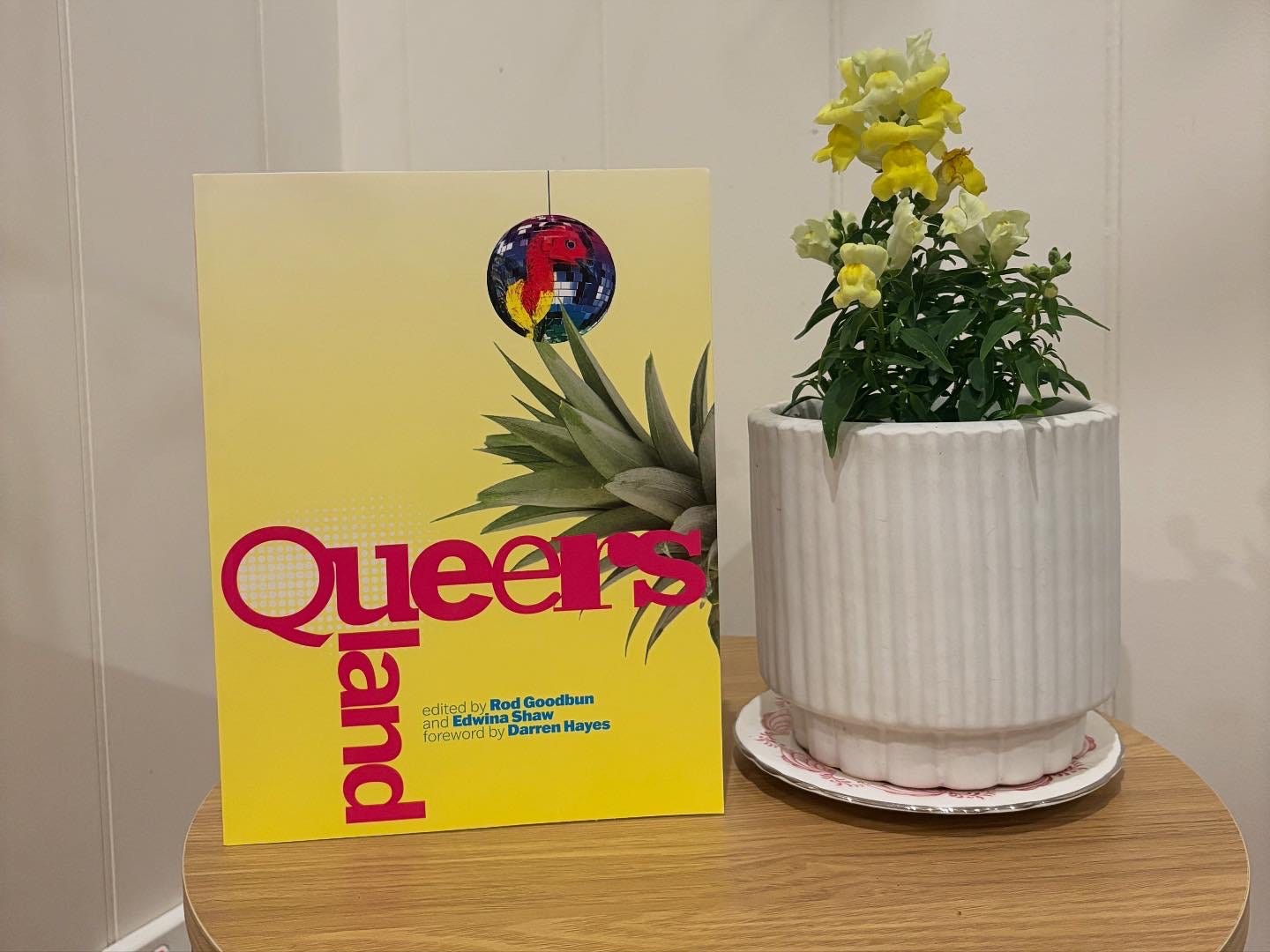
QUEERSLAND
Edited by Rod Goodbun and Edwina Shaw
Published by AndAlso Books
If you write in, or about, Queensland, you need to get a copy of QUEERSLAND. The anthology covers decades of the state’s history, culture, mistakes and triumphs, told from a queer, local perspective.
“Being queer is magical, extraordinary, and essential to society. But we exist in society where our very existence is fragile and can be taken away in the blink of an eye. It is imperative to remember our history and never forget how we got here,” writes musician Darren Hayes in the foreword.
Hayes, who grew up in Logan, sets the tone for 38 pieces that are immersive, brave and vulnerable, fraught and hopeful.
Escape is a theme. People flee small northern sugar towns for the bright lights and anonymity of Brisbane; others flee the claustrophobia of Brisbane for cosmopolitan cities in the south. Destination is another leitmotif: for many the possibilities of living somewhere else is life changing and empowering. I moved to QLD at the age of 18, from Tasmania, to attend the University of Queensland. Many of the stories or references stir memories and recollections of student campus politics at that time. Still, I learned a lot – including that Qld gives Tasmania a run for its money when it comes to gay law reform, with homosexuality illegal in Queensland until 1989. I hadn’t quite realised that.
The Joh Bjelke Petersen years provide an ominous backdrop for many of the writers’ stories. Aunty Dawn Daylight talks about how it wasn’t safe for an Aboriginal woman to walk around the streets, and as a gay woman she felt that doubly: “People weren’t out. If they were out, they got lifted by the cops.”
Odette Best describes working as a psychiatric nurse in 1990 at the infamous P2 Ward at Princess Alexandria Hospital where Electronic Convulsive Treatment was being used on patients. This story, among many, you read with your heart in your throat.
In the delicate, evocative Heartstring, set in 1945 on a river tugboat as the Yanks are taking over the city, Wolfram Jaymes-Keesing explores the idea of marriage and what it means when society binds people who don’t truly love each other. Connor Crossley describes the intensity of living in a river city that floods, the strangeness of climate crisis lies, and a boy’s coming-of-age against this backdrop of danger and denial, in his wonderful story Two Men, One Apocalypse.
It’s worth reading for the vivid Brisbane nostalgia. In Welcome to Brisvegas, musician James Lees takes us from a Highgate Hill share house into the vibrant dark rooms of Options nightclub, The Zoo, The Cockatoo Club and Van Gogh’s earlobe, all havens of creativity and inclusivity. A kid from Caloundra, James embraces the richness of Brisbane, writing for Rave magazine, working on the Brisbane Pride Festival committee, joining a band. Ruth Gardner brings to life 4ZZZ FM’s Dykes on Mykes radio show, and the letters they received over several decades from a subscriber who listened clandestinely while her husband was at work. There are many stories within stories in QUEERSLAND.
Feminist politics and social activism are particularly interesting topics. In the essay Imagine Living In a World, Chantal Eastwell and Karin Cheyne, chart their work in the Women’s House in the 1980s, the rallies, marches and meetings in Brisbane, and the impact of guerilla movements. “Before social media, graffiti was a thing. Dyke Bridge on Boundary Street, West End, was a favourite place to spread the word. Obligingly, the Brisbane City Council provided and endless blank canvass by painting over the graffiti regularly.”
Kris Kneen’s story Something Other is exquisite. I read it several times. It’s overwhelming in its vulnerability and the powerful beauty of the prose. Steve Minon’s Saturday Night Poofta is similarly moving. MinOn takes a humorous approach as he reflects on going to the Prosperine cinema to watch a John Travolta movie in 1978, making the reader reflect on the relationship between comedy, trauma and healing. Georgina Maxine writes a striking, heartfelt piece about her experience as an asexual, biromantic writer: “It doesn’t feel normal in this world right now, but maybe one day it will.”
This anthology is a treasure chest of Queensland stories. Mentioned here is just the tip of the iceberg; there’s so much more to discover inside the gorgeous yellow cover. QUEERSLAND has incredible energy and heart, and it lingers with you, which is the mark of good writing. I admire the writers’ courage, vulnerability and honesty. Reading their stories compels me to be a better, braver writer.